
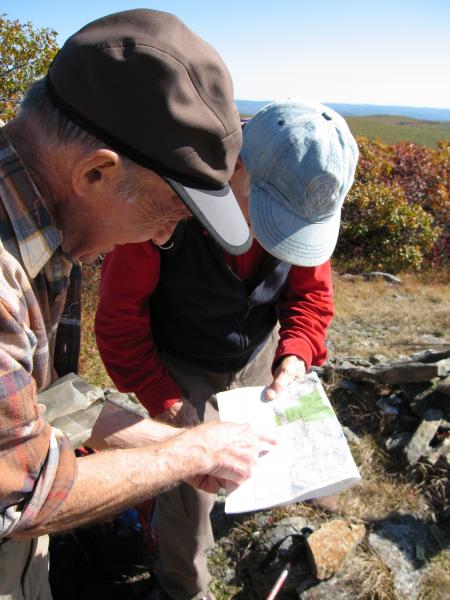
 Map & Compass
A good map in your pocket is a reliable tool and still highly recommended when venturing in the outdoors. It doesn't run out of power and you don't have to depend on satellite reception. Basic compass skills also never go out of date. For an introduction to map and compass use, click here.
Compass caution in New York-New Jersey: Be aware that the New York-New Jersey area has many iron mines scattered about that can affect the accuracy of a compass. It is also worth noting that you will be off by about 90 feet per mile for each degree of error, so ignoring the difference between magnetic north and true north can result in a serious error. The declination changes with time. Look at the date of the declination information on any USGS topo and be aware that it could be off by a few degrees if it is not a recent map.
UTM Grids: The New Way of Using Maps
All current editions of Trail Conference maps have a UTM grid. These are the fine blue lines on the maps, which are based on the Universal Transverse Mercator (UTM) projection. These lines form squares of a kilometer (1,000 meters, or approximately 0.62 mile) on each side (note: our Catskill Trails maps have squares of 2km on each side). The grid can be used to estimate distances at a glance. The UTM grid is particularly useful for hikers with a GPS receiver, making it possible for a hiker to find his/her location on the map with ease and accuracy (GPS receivers should be set for UTM coordinates (rather than latitude and longitude) and to the map datum NAD83).
The side edges of the maps are marked with the "northings," e.g., 4588000N (which represents the distance in meters north of the equator), and the top and bottom edges are marked with the "eastings," e.g., 585000E (which, minus 500,000, is the distance in meters from the centerline of Zone 18, in which New York is located). For example, on East Hudson Trails map 102, the trailhead of the Breakneck Ridge Trail in Hudson Highlands State Park is at the intersection of 4588000N and 585000E.
Comment: Please be relevant, civil, non-commercial.
UTM Grid Squares
Re: UTM Grid Squares