
 Get Directions
Although comprising only 190 acres, Cranberry Lake Preserve is surrounded on several sides by...
Hike Description:
Although comprising only 190 acres, Cranberry Lake Preserve is surrounded on several sides by 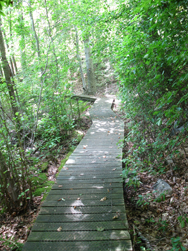 watershed lands. It is a quiet oasis in the midst of suburban Westchester County and offers a pleasant walk around a tranquil lake. Trail junctions in the preserve are marked by numbered wooden signs, and the numbers are referenced in this description.
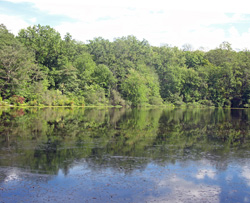
From the Nature Center, proceed south on a wide yellow-blazed path. At a blue sign to the "Lake" (junction #4), turn left and follow an orange-blazed trail downhill to the shore of Cranberry Lake, then turn right (at junction #26) onto a trail with blue and yellow blazes. After briefly following the lake shore, the trail climbs to ledges overlooking the lake, continuing to parallel it. At the end of the lake, it descends. After crossing a boardwalk, the trail reaches junction #6.
Turn left onto a wide path, and following blue, purple and red blazes, then turn left at the next junction (#7) onto an orange-blazed trail, immediately crossing the Bent Bridge over a bog. The trail runs along old stone walls and passes the "stone chamber" – probably an old root cellar. At the end of the orange trail (junction #16), turn right onto a wide path (an old railraod bed) and follow it 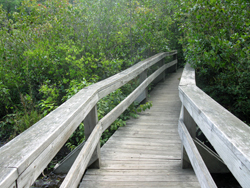 to a Y-intersection, with a sign for the New York City Watershed grown into a tree (junction #18).
Bear left here, now following the Red Loop Trail. This trail, which circles the park, will be your route for most of the remainder of the hike. On the right, marking the boundary between the park and New York City Watershed lands, is an expertly-laid dry stone wall, built over a century ago and still in nearly perfect condition today (except where damaged by fallen trees). Soon, the trail bears left and heads south, continuing to follow the wall.
At the southern end of the park, with private homes visible ahead through the tree, the red trail turns left and begins to head east. Be alert for a sharp right turn (marked by an arrow on a tree to the left) and head downhill toward Hush Pond, continuing to follow the red trail. Cross the outlet of the pond on puncheons, bear left (north), and soon begin to parallel a wetland on the left. In a short distance, you’ll join a level dirt road, with cliffs on the right.
Soon, the cliffs are supplanted by a concrete wall. This wall is a remnant of a facility built about 1912 to 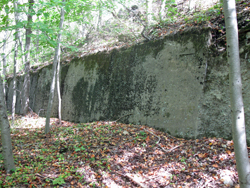 crush stone that was quarried just to the east of the trail and used for the construction of the Kensico Reservoir. Just beyond a crumbling section of the wall, you’ll reach junction #13, where a blue-blazed trail leads left to a wooden observation platform. Unfortunately, the view over South Pond is largely obscured by vegetation.
Return to the main trail and turn left (north), now following both blue and red blazes. Soon, you’ll reach a small cascade with a bench (junction #14). Just beyond the bench, turn right, leaving the wide road, and cross the stream on a wooden footbridge, continuing to follow blue and red blazes. At the next fork, bear right and proceed along the Red Loop Trail through a mountain laurel thicket. After a short climb, you’ll reach junction #20, where the Purple (History) Loop, marked with purple-on-white blazes, joins from the right.
 The trail now descends rather steeply. At the base of the descent (junction #21), the blue trail joins from the left, and the trails cross a boardwalk. Just beyond, at junction #22, the trails again split. Bear right, continuing to follow the red and purple-on-white trails, which cross another boardwalk. Bear right at junction #23, continuing to follow the red and purple-on-white blazes.
After curving to the left, the trail reaches a T-intersection (junction #34), with cliffs ahead. Here, the red and purple-on white trails turn right, but you should turn left, now following yellow blazes. At the next junction (#33), bear left, continuing to follow the yellow blazes, and descend to the lake. At junction #24, turn right and follow yellow and blue blazes, with the trail paralleling Cranberry Lake. After passing junction #27, you'll reach a viewpoint over the lake (with the view partially obstructed by vegetation). Just beyond, you’ll reach junction #26. Turn right onto the orange trail, follow it back up to the yellow trail at junction #4, and turn right on the yellow trail to return to the Nature Center where the hike began.
Publication: Submitted by Daniel Chazin on 02/25/2005 updated/verified on 06/29/2018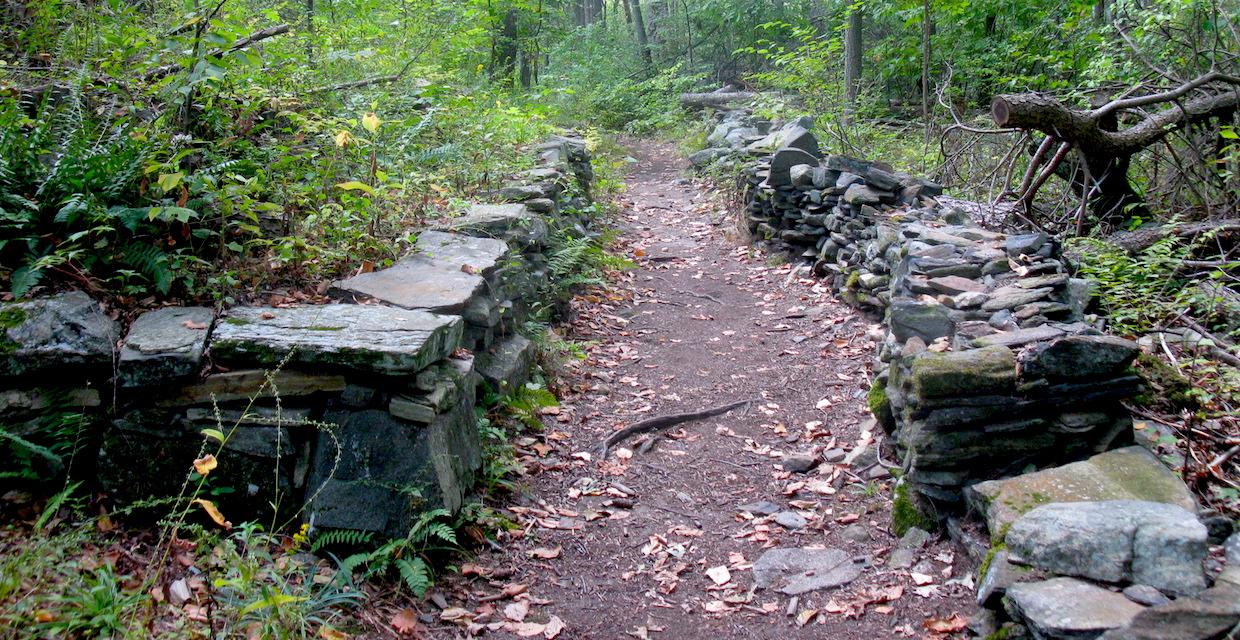
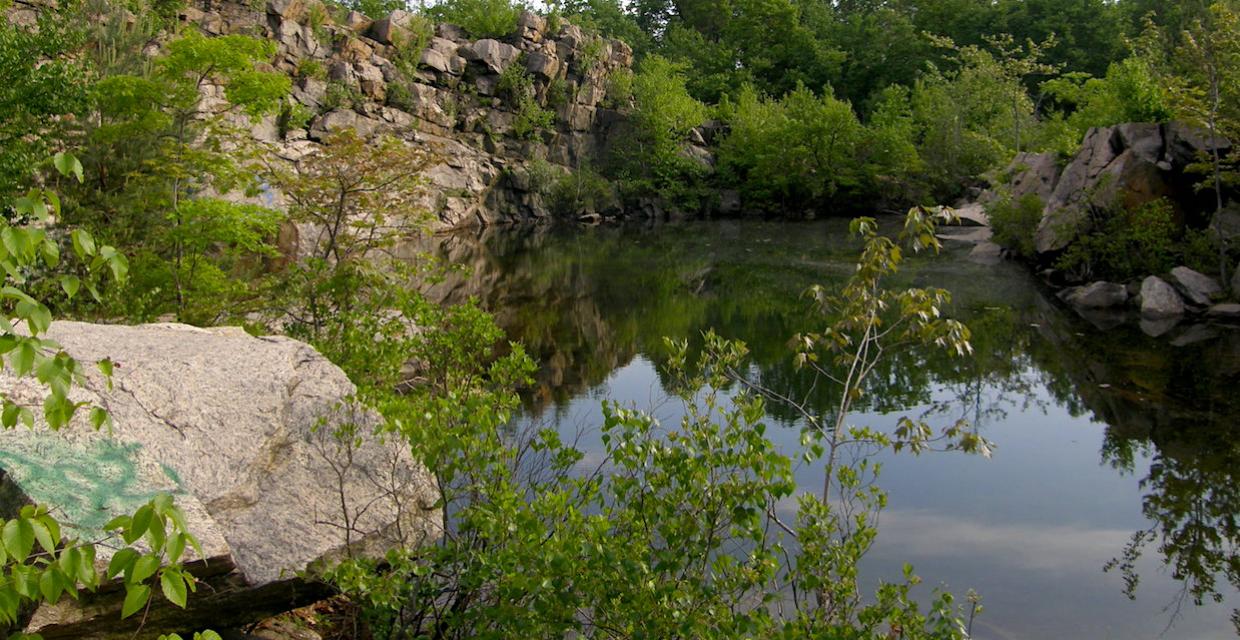
Remenants of quarry operations, old stone walls,a small cascade, and scenic Cranberry Lake are features on this hike at Cranberry Lake Preserve.
41.081923, -73.755898
Westchester Co., NY
3 mi
2 hrs

Web Map: Cranberry Lake Trail Map
Buy Book: Walkable Westchester
Hike Checklist:
Whether you are going for a day hike or backpacking overnight, it is good practice to carry what we call The Hiking Essentials. These essentials will help you enjoy your outing more and will provide basic safety gear if needed. There may also be more essentials, depending on the season and your needs.
The Essentials
Hiking Shoes or Boots
Water - Two quarts per person is recommended in every season. Keep in mind that fluid loss is heightened in winter as well as summer. Don't put yourself in the position of having to end your hike early because you have run out of water.
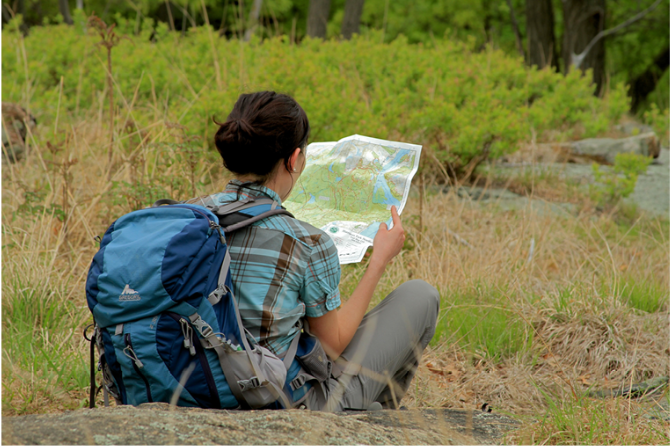
Map - Know where you are and where you are going. Many of our hiking areas feature interconnecting network of trails. Use a waterproof/tear-resistant Tyvek Trail Conference map if available or enclose your map in a Ziplock plastic bag. If you have a mobile device, download Avenza’s free PDF Maps app and grab some GPS-enhanced Trail Conference maps (a backup Tyvek or paper version of the map is good to have just in case your batteries die or you don't have service). Check out some map-reading basics here.
Food - Snacks/lunch will keep you going as you burn energy walking or climbing. Nuts, seeds, and chocolate are favorites on the trail.
Sunscreen and insect repellent
Rain Gear and Extra Clothing - Rain happens. So does cold. Be prepared for changing weather. Avoid cotton--it traps water against your skin and is slow to dry. If you are wearing wet cotton and must return to your starting point, you risk getting chills that may lead to a dangerous hypothermia. Choose synthetic shirts, sweaters and/or vests and dress in layers for easy on and off.
Compass - A simple compass is all you need to orient you and your map to magnetic north.
Light - A flashlight or small, lightweight headlamp will be welcome gear if you find yourself still on the trail when darkness falls. Check the batteries before you start out and have extras in your pack.
First Aid Kit - Keep it simple, compact, and weatherproof. Know how to use the basic components.
Firestarter and Matches - In an emergency, you may need to keep yourself or someone else warm until help arrives. A firestarter (this could be as simple as leftover birthday candles that are kept inside a waterproof container) and matches (again, make sure to keep them in a waterproof container) could save a life.
Knife or Multi-tool - You may need to cut a piece of moleskin to put over a blister, repair a piece of broken equipment, or solve some other unexpected problem.
Emergency Numbers - Know the emergency numbers for the area you're going to and realize that in many locations--especially mountainous ones, your phone will not get reception.
Common Sense - Pay attention to your environment, your energy, and the condition of your companions. Has the weather turned rainy? Is daylight fading? Did you drink all your water? Did your companion fail to bring rain gear? Are you getting tired? Keep in mind that until you turn around you are (typically) only half-way to completing your hike--you must still get back to where you started from! (Exceptions are loop hikes.)
Check the weather forecast before you head out. Know the rules and regulations of the area.
The Leave No Trace Seven Principles
Plan Ahead and Prepare
- Know the regulations and special concerns for the area you'll visit.
- Prepare for extreme weather, hazards, and emergencies.
- Schedule your trip to avoid times of high use.
- Visit in small groups when possible. Consider splitting larger groups into smaller groups.
- Repackage food to minimize waste.
- Use a map and compass to eliminate the use of marking paint, rock cairns or flagging.
Travel and Camp on Durable Surfaces
- Durable surfaces include established trails and campsites, rock, gravel, dry grasses or snow.
- Protect riparian areas by camping at least 200 feet from lakes and streams.
- Good campsites are found, not made. Altering a site is not necessary.
- In popular areas:
- Concentrate use on existing trails and campsites.
- Walk single file in the middle of the trail, even when wet or muddy.
- Keep campsites small. Focus activity in areas where vegetation is absent.
- In pristine areas:
- Disperse use to prevent the creation of campsites and trails.
- Avoid places where impacts are just beginning.
- Pack it in, pack it out. Inspect your campsite and rest areas for trash or spilled foods. Pack out all trash, leftover food and litter.
- Deposit solid human waste in catholes dug 6 to 8 inches deep, at least 200 feet from water, camp and trails. Cover and disguise the cathole when finished.
- Pack out toilet paper and hygiene products.
- To wash yourself or your dishes, carry water 200 feet away from streams or lakes and use small amounts of biodegradable soap. Scatter strained dishwater.
- Preserve the past: examine, but do not touch cultural or historic structures and artifacts.
- Leave rocks, plants and other natural objects as you find them.
- Avoid introducing or transporting non-native species.
- Do not build structures, furniture, or dig trenches.
- Campfires can cause lasting impacts to the backcountry. Use a lightweight stove for cooking and enjoy a candle lantern for light.
- Where fires are permitted, use established fire rings, fire pans, or mound fires.
- Keep fires small. Only use sticks from the ground that can be broken by hand.
- Burn all wood and coals to ash, put out campfires completely, then scatter cool ashes.
- Observe wildlife from a distance. Do not follow or approach them.
- Never feed animals. Feeding wildlife damages their health, alters natural behaviors, and exposes them to predators and other dangers.
- Protect wildlife and your food by storing rations and trash securely.
- Control pets at all times, or leave them at home.
- Avoid wildlife during sensitive times: mating, nesting, raising young, or winter.
Be Considerate of Other Visitors
- Respect other visitors and protect the quality of their experience.
- Be courteous. Yield to other users on the trail.
- Step to the downhill side of the trail when encountering pack stock.
- Take breaks and camp away from trails and other visitors.
- Let nature's sounds prevail. Avoid loud voices and noises.
The Trail Conference is a 2015 Leave No Trace partner.
(c) Leave No Trace Center for Outdoor Ethics: www.LNT.org.
 Directions to Trailhead
 Public Transportation
Directions to Trailhead :
From the Bronx River Parkway at the Kensico Dam, take Route 22 North Once past the dam, turn right at a traffic light onto Old Orchard Street. In about 100 feet, turn right into the Cranberry Lake Preserve, and continue ahead for 0.3 mile to the Nature Center, where parking is available. (If the entrance gate is closed, park outside the gate and walk along the road.)
TRAIN TRANSPORT :
Not availableBUS TRANSPORT :
Not availableShare Your Experience
SUPPORT
 Support the trails with a donation!
Trail Conference volunteers maintain trails in this hike.
Trip Reports
rate experience June 05, 2016
were any of these issues
<p>were any of these issues taken care of .... Or are the trails good to go?</p>
March 11, 2016
Cranberry Lake Confusion
<p>My husband and i did this little hike on 3/11/16, near the end of a winter that was oddly warm and had very little precipitation of any kind. It was extremely hard to find the Preserve coming from the north (we wish your "find-a-hike" section included directions for people coming from north of Rockland or Putnam counties). Then when we got there, we found the blazes on the trails to be few and far between -- and confusing. (The "purple" blazes consist of a faint, washed-out pink on a white square, for example.) To make matters worse, the maps at the Nature Center are black-and-white and it's hard to read the legend for the blazes. Worst of all, when you can figure out the preserve's map, it doesn't match the NYNJTC map! We're glad we stopped at the nature center, though, because they told us that two of the bridges mentioned in your directions are washed out. Also, it was very muddy and even a bit buggy, despite this being early March!</p>
<p>All in all, we were a bit disappointed.</p>
August 13, 2012
Virtual Tour of Cranberry Lake Preserve!
<p>Great Description of a wonderful hike! Check out NJUrbanForest.com's description of this beautiful preserve!</p>
<p>http://njurbanforest.com/2012/08/13/westchester-countys-cranberry-lake-preserve/</p>
<p>Packed with photos!</p>